Aardvark Jazztet: Duke Ellington Celebration

The Aardvark Jazztet will celebrate Ellington’s 120th Birthday with music spanning four decades. Selections from the Swing Era will include favorites such as Solitude, In a Mellotone, and Billy Strayhorn’s theme song for the Ellington Orchestra, Take the A Train. Ellington’s film music will be represented by Pie Eye’s Blues from the score for Otto Preminger’s Anatomy of a Murder, and the Duke’s theatrical dimension will be heard in the lovely ballad I Got It Bad (and That Ain’t Good) from the musical Jump for Joy. The group will celebrate Duke’s late-period sacred music with the toe-tapping bossa nova Heaven from The Second Sacred Concert.

WCCMA is committed to making music accesible for all. Suggested freewill offering for this concert is suggested at $25 Adults, $20 Members, $5 Students, $40 for families.

___________


Founded in 1973, The Aardvark Jazz Orchestra has been a force in the international jazz scene for more than 40 years. Aardvark is one of the longest-running large jazz ensembles in the world. The band is well known for its wide-ranging shows, from new music by founder/director Mark Harvey to classics and rarities by Duke Ellington, Count Basie, Mary Lou Williams, Miles Davis, John Coltrane and other jazz legends. Aardvark has given premieres of more than 175 works for jazz orchestra, performs widely, and appears on 14 CDs, including 8 discs from Leo Records, one of the world’s leading adventuresome music labels. Guest artists who have appeared with Aardvark include jazz luminaries Jaki Byard, Sheila Jordan, Jimmy Giuffre, Geri Allen, Raj Mehta, Dominique Eade, Lewis Porter, and Matt Savage, to name a few.

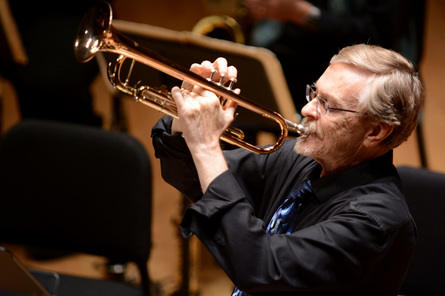
Mark Harvey on trumpet

Composer/trumpeter ​Mark Harvey is the founder and music director of the Aardvark Jazz Orchestra and teaches jazz studies and composition at MIT. Harvey has performed in major venues including Fenway Park and Symphony Hall, Boston, the Knitting Factory and the Village Gate (NYC), the National Gallery of Art (DC), the Left Bank Jazz Society (MD), the Southern California Institute of Architecture (CA), the Berlin Jazz Festival (Germany), and the Baja State Theater (Mexico). His musical credits also include recordings with George Russell’s Living Time Orchestra (Blue Note), and Baird Hersey & the Year of the Ear (Arista/Novus) and appearances with Gil Evans, Howard McGhee, Sam Rivers, Claudio Roditi, and other notables.

Harvey has received commissions from the Meet the Composer/Lila Wallace-Reader’s Digest Commissioning Program, the 15th Annual John Coltrane Memorial Concert, FiLmprov, the the MIT Sesquicentennial Celebration, Organization of American Kodaly Educators,and the MIT Festival Jazz and Wind Ensembles, among others. In 2015, Dr. Harvey was named Boston Jazz Hero by the Jazz Journalists Association, one of 24 jazz advocates/activists recognized nationally.

Kinan Azmeh and Dinuk Wijeratne, with CityBand

Celebrated artists from “The Art of the Duo” collaborate with the virtuosic CityBand in a high-energy night fusing classical, jazz, and Middle Eastern originals. Admission is by donation, suggested at $25 Adults, $20 Members, $5 Students, $40 for families. For more information visit wcc-ma.orgThis concert is part of the 2-day Music Experience with Saint-Gaudens Memorial (sgnhs.org), an immersive opportunity to explore great artists across 2 days and 2 locations.

___________


Sri Lankan-born Canadian Dinuk Wijeratne is a JUNO award-winning composer, conductor, and pianist who has been described by the Toronto Star as ‘an artist who reflects a positive vision of our cultural future’, and by the New York Times as ‘exuberantly creative’. His boundary-crossing work sees him equally at home in collaborations with symphony orchestras and string quartets, tabla players and DJs, and takes him to international venues as poles apart as the Berlin Philharmonie and the North Sea Jazz Festival.

Dinuk made his Carnegie Hall debut in 2004 as a composer, conductor, and pianist, performing with Yo Yo Ma and the Silk Road Ensemble. A second Carnegie appearance followed in 2009, alongside tabla legend Zakir Hussain. Dinuk has also appeared at the Kennedy Center (Washington DC), Opera Bastille (Paris), Lincoln Center (New York), Teatro Colón (Buenos Aires), Sri Lanka, Japan, and across the Middle East.

Dinuk grew up in Dubai before taking up composition studies at the Royal Northern College of Music (RNCM), Manchester, UK. In 2001, he was invited by Oscar-winning composer John Corigliano to join his studio at New York’s Juilliard School. Dinuk was also composition fellow at the 2002 Pacific Music Festival in Sapporo, Japan, and was appointed Artist-in-Residence by the Performing Arts Foundation at International House for the 2003/4 season. Conducting studies followed at New York’s Mannes College of Music, and doctoral studies at the University of Toronto under Christos Hatzis.

Dinuk has composed specially for almost all of the artists and ensembles with whom he has performed; to name a few: Suzie LeBlanc, Bev Johnston, Tim Garland, John Dankworth, Nikki Iles, Julian Argüelles, Victor Mendoza, Buck 65, Skratch Bastid, Joseph Petric, Nick Halley, Ed Thigpen, Pandit Ramesh Misra, Adrian Spillett, David Jalbert, Kevork Mourad, Mayookh Bhaumik, Yolande Bavan, Christina Courtin, MIR, the Afiara & Cecelia String Quartets, the Apollo Saxophone Quartet, TorQ & 4-Mality Percussion Quartets, McGill Percussion Ensemble, the NY Kathak Ensemble, the New Juilliard Ensemble, Onelight Theatre, Symphony Nova Scotia, and the orchestras of Toronto, Illinois, Windsor, and KwaZulu Natal (South Africa). He continues his collaborative recitals of entirely original works with acclaimed clarinetist Kinan Azmeh, based on their duo album entitled ‘Complex Stories, Simple Sounds’.

A passionate educator, Dinuk has lectured at the universities of Dalhousie, Acadia and Saskatchewan, and is in his twelfth season as Music Director of the Nova Scotia Youth Orchestra. He has conducted the orchestras of the National Arts Centre, Thunder Bay, PEI, Scotia Festival Orchestra, and appeared numerous times with Symphony Nova Scotia during his 3-year appointment as Conductor-in-Residence. He is the recipient of the Canada Council Jean-Marie Beaudet award for orchestral conducting; the NS Established Artist Award; NS Masterworks nominations for his Tabla Concerto and piano trio Love Triangle; double Merritt Award nominations; Juilliard, Mannes & Countess of Munster scholarships; the Sema Jazz Improvisation Prize; the Soroptimist International Award for Composer-Conductors; and the Sir John Manduell Prize – the RNCM’s highest student honor. His music and collaborative work embrace the great diversity of his international background and influences.


_________________

Hailed as a “Virtuoso” and “Intensely Soulful” by the New York Times and “Spellbinding”  by the New Yorker, and “Incredibly Rich Sound” by the CBC.  His utterly distinctive sound across different musical genres has gained him international recognition as  clarinetist and composer. Kinan was recently named composer-in-residence with Classical Movements for the 2017-2018 season.

Kinan has been touring the world as soloist, composer and improviser. Notable appearances include: Opera Bastille, Paris; Tchaikovsky Grand Hall, Moscow; Carnegie Hall and  the UN’s general assembly, New York; the Royal Albert hall, London; Teatro Colon, Buenos Aires; der Philharmonie; Berlin; the Library of Congress, the Kennedy Center, Washington DC; the Mozarteum, Salzburg, Hamburg’s Elbphilharmonie and the Damascus opera house for its opening concert in his native Syria.

He has appeared as soloist with the New York Philharmonic, the Seattle Symphony, the Bavarian Radio Orchestra,  the West-Eastern Divan Orchestra, the Qatar Philharmonic and the Syrian Symphony Orchestra among others.; and has shared the stage with Yo-Yo Ma, Marcel Khalife, Aynur, Daniel Barenboim and Jivan Gasparian.

His compositions include several works for solo, orchestra, and chamber music; film, live illustration, and electronics. His discography include three albums with his ensemble Hewar,  several soundtracks for film and dance,  a duo album with pianist Dinuk Wijeratne and an album with his New York Arabic/Jazz quartet the Kinan Azmeh CityBand.  He serves as artistic director of the Damascus Festival Chamber Players, a pan-Arab ensemble dedicated to contemporary music form the Arab world. His is a frequent guest faculty at the Apple Hill Center for Chamber Music and is on the advisory board of the Nova Scotia Youth Orchestra. He is also a member of Yo-Yo Ma’s Silk Road Ensemble with whom he was awarded a Grammy in 2017.

Kinan is a graduate of New York’s Juilliard school as a student of Charles Neidich, and of both the Damascus High institute of Music where he studied with Shukry Sahwki, Nicolay Viovanof and Anatoly Moratof, and Damascus University’s School of Electrical Engineering in his native Syria.  Kinan earned his doctorate degree in music  from the City University of New York in 2013.


_____________

Formed in 2006 in New York City, the Kinan Azmeh CityBand immediately gained recognition for their virtuosic and high energy performance, receiving praise from critics and audiences alike.

With this New York ensemble, Azmeh strives to reach a balance between classical music, jazz, and the music of his homeland, Syria. Azmeh’s expressive clarinet meets Kyle Sanna’s rustic guitar, soaring at times over the dynamic and volatile backdrop of John Hadfield’s percussion and Josh Myers’ double bass. Each band member has come from varied backgrounds to add their personal flair to this ensemble, resulting in a thoroughly exciting and rewarding listening experience.
The quartet has toured the US, France, England, Germany, Holland, Egypt, lebanon,and Turkey.
 

Yankee Brass Band

The Yankee Brass Band bring triumphant horns from America’s Golden Age of band music to WCCMA’s Summer Concert Series. Join us for Quicksteps, gallops, polkas, waltzes, popular overtures of the mid-19th century, and more on period brass instruments.

WCCMA is committed to making music accesible for all. Suggested freewill offering for this concert is suggested at $15 Adults, $5 Students, $30 for families.

More info about the Yankee Brass can be found at: yankeebrassband.org

________

HISTORY OF THE YANKEE BRASS BAND

In 1986, Paul Maybery of St. Paul, Minnesota, Mark Elrod of Germantown, Maryland, and a small number of brass players from around the country gathered at the Hotel Coolidge in White River, Junction. Vermont. The result of this initial gathering was the performances of the Yankee Brass Band in the Upper Valley of Vermont/New Hampshire. What was created was an historically accurate recreation of an American Brass Band circa 1840–1870 performing music of the period in an appropriate style and on the original instruments. Pictures of the band show the musicians in reproductions of “uniforms” that were common attire for bands of the era –  firemen’s shirts (red flannel shirts) and red kepis.

In 1977, the Minnesota Historical Society invited Maybery and his quintet to play period music at its annual meeting. While delving into the historical collections of Minnesota, Maybery became “hooked” on the music and instruments of the 19th century. His first project was to reconstruct the music of Russell Munger’s Great Western Band of St. Paul.

Using old posters and band programs that gave him clues to titles of songs, Maybery went on a search for the original musical scores of the 1850s and 60s. David Briggs, an old college band friend, and one of the directors of the River City Arts Forum of Hartford, Vermont, provided Maybery with a contact in the East.

In Manchester, New Hampshire, Maybery discovered the Dignam collection of music where he found many of the pieces for which he had been searching. Walter Dignam was the leader of the famed Manchester Cornet Band, which had the distinction of performing for President Franklin Pierce. Due to the costliness of printed material in the 19th century, music was copied by hand and passed on from band to band. This enabled Maybery to find surviving copies of music in the Dignam collection and several pieces common to both the Great Western Band and the Manchester Cornet Band.

Not only are the largest collections of period music located here in New England, but many local town bands still have them in their libraries. The Nevers Band of Concord (N.H.) still uses its ancestor’s (the 2nd N.H. Regiment’s Band) music books.

Each July, the Friends of the Yankee Brass, Inc., brings together musicians from all over the country to perform in the Yankee Brass Band. They come as true enthusiasts of the old time band, eager for a chance to play on the 19th century instruments. Some instruments are provided by collectors such as Mark Elrod, Jon Hall, and Wayne Collier. Several of the musicians own authentic 19th century brass instruments. The earliest instrument is a bass drum from approximately 1835, owned by Jon Hall, of Portland, Maine.

Some of the instruments play much like modern ones, but others require some adjustments. “A lot of these musicians don’t know what they are getting into,” says Paul Maybery. “They are playing 140-year old instruments that don’t transcribe well for modern music. Once they hear it, and play it, though, they are hooked. It’s contagious!”

The modern musicians do have to adapt to the valve action on the antique instruments. Today’s horns, such as trumpets or cornets, use piston valves—a piston moves up and down to shorten or lengthen the tube of the brass instrument, altering the pitch. Some of the old instruments have valves using a rotary action—the valves revolve rather than plunge to alter the length of the tube.

Aside from these differences, the instruments have some modern names: tuba, B-flat and E-flat cornets, alto horn, tenor horn, and baritone horn. But, there are two instruments in the band which have become extinct in the modern era—the keyed bugle and the ophicleide.

Several members of the current Yankee Brass Band were involved in the production of the PBS Civil War series, and Maybery assisted in the arrangement of the historic music. Maybery also appeared as guest conductor at the Ford’s Theatre Commemorative Concert on the anniversary of Lincoln’s assassination. Some historic instruments of this period were seen in the Civil War film Glory.

The musicians in the Yankee Brass Band come from all walks of life—engineers, doctors, teachers, consultants, professional musicians and other enthusiasts—like those musicians of the bands of the last century. These people come from around the United States to share a common love and respect for the music of the early brass bands. Many of them direct or perform with similar bands in their own home towns.

The combined expertise of these musicians produces one of northern New England’s most entertaining and informative musical events. With its collection of antique instruments and authentic music scores, the Yankee Brass Band gives the audience an auditory living-history experience they will long remember. The quicksteps, gallops, polkas, mazurkas, schottisches and waltzes, and the many overtures and medleys popular in the mid-19th century make up the program of the typical brass band concert of yesteryear.

The members of the Friends of the Yankee Brass, Inc., the musicians of the Yankee Brass Band, and director Paul Maybery encourage serious scholarship and research. Their goals are to create a “heightened awareness” of the traditions of historic American band music, instruments, celebrated personalities, brass band literature, and styles of historic performance practice. These goals are accomplished through scholarly research and application in presentations of an educational nature.